
Bitcoin Casinos in Canada 2026: How to Judge Licensing, Deposit Speeds and Payout Reliability Before You Sign Up
Bitcoin Casinos in Canada 2026: How to Judge Licensing, Deposit Speeds and Payout Reliability Before You Sign Up
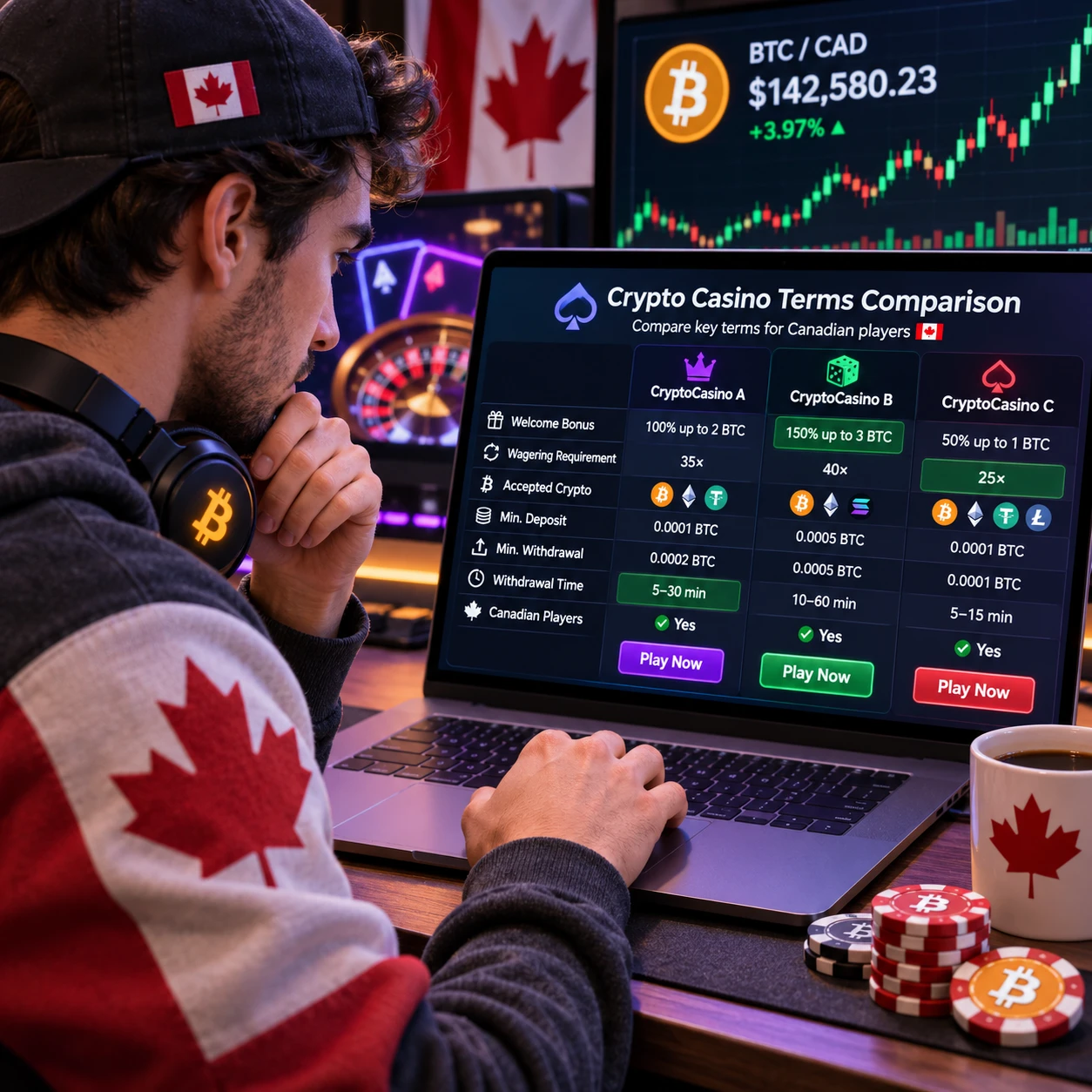
I've had this same conversation with readers more times than I can count. Someone deposits $200 in bitcoin, it clears in about ninety seconds, they win a little, and then they spend four days refreshing a withdrawal page that just says 'pending.' Same account. Same platform. Two totally different experiences.
The deposit was instant because platforms make money on deposits. The withdrawal was slow because platforms lose money on withdrawals. That asymmetry is the whole game, and once you see it, the marketing stops working on you — the bonus banners, the 'fast payouts' badges, all of it starts reading like what it is.
So this isn't a review. It's a buyer's guide: a repeatable filter you can apply to any crypto-friendly platform, in any province, in 2026. I go licensing first, deposit mechanics second, payout behaviour third, because each step costs you less to check than the one after it. Then I'll show you where I've run that same filter across a curated shortlist, so you've got a place to start instead of forty tabs and a headache.
Why the Canadian Market Needs Its Own Checklist in 2026
Canada isn't one gambling market, and that's where most of the confusion starts. Ontario runs a licensed iGaming model overseen by the AGCO and iGO — operators have to be registered there, have to verify identity, and have to follow rules on advertising and payment processing. Players in Alberta, British Columbia, Quebec, the Prairies and Atlantic Canada are living in a different reality: provincial lotteries run their own products, offshore operators fill the gap, and enforcement is patchy and provincial rather than federal.
Then you add the crypto layer on top. Most Canadians still fund accounts with Interac e-Transfer, which is where the CAD on-ramp actually lives, so a site has to bridge three things at the same time: your bank, your bitcoin, and a CAD-denominated balance. Get any one of those wrong and you feel it at the worst moment.
The tax side deserves a mention too. The CRA's general position is that gambling winnings aren't taxable income — but that doesn't mean records don't matter. If you're buying and selling crypto to fund play, capital gains rules can surface, and a platform that won't give you clean statements makes your life harder in April. I've watched people reconstruct a year of transactions from memory. It's not fun.
Here's my thesis, plainly: because enforcement varies by province, the due diligence lands on you. Which is why a fixed checklist beats star ratings, affiliate rankings, and whatever a forum user swore by three years ago.
What Changed Going Into 2026
The direction of travel is clear even where the exact dates aren't. Know-your-customer checks that used to show up only at cash-out are increasingly being run at sign-up by the more serious operators. More brands geo-block Ontario rather than bother with AGCO registration, so a site that worked fine from Toronto in 2022 may now refuse that address outright. And crypto deposits have gone from novelty to default: most platforms that took Interac in 2020 now treat BTC, LTC and USDT as first-class funding methods.
The novelty has moved to the withdrawal side. Which is exactly where you should be looking.
Licensing — The Filter That Eliminates Half the Field
A licence isn't a badge. It's a mechanism. What it actually buys you is a named regulator you can complain to, some expectation of processing timelines, a requirement to keep player funds segregated in certain jurisdictions, and a party with real authority to act when a withdrawal stalls. Strip those four things away and 'licensed' is just a word printed on a page.
So the first question isn't 'is it licensed.' It's 'licensed by whom, and does that regulator reach a Canadian player?' A provincial registration like the AGCO's is the strongest position for Ontario residents — it comes with actual local recourse. Kahnawake and Malta are recognised and generally responsive. Curacao and Anjouan are the common, lighter-touch regimes: they exist, they process some complaints, and they won't move fast or forcefully on your behalf.
None of that makes those operators automatically bad. It changes what you're relying on — usually the operator's own reputation instead of a regulator's leverage. Worth knowing before you send money, not after.
Reading the Footer in 60 Seconds
Here's the actual procedure I use, and it takes under a minute. Scroll to the footer and click the licence seal — if nothing happens, that's already information. Take the licence number and search the regulator's public register directly rather than trusting the seal image. Match the operating company name in the terms against the brand on the homepage; a mismatch isn't automatically fatal, but it should at least be explained somewhere. Then search the terms and conditions for your province's name to confirm you're not silently excluded.
Red Flags Worth Walking Away From
An unlinked seal. A licence number that resolves to a completely different domain in the register. Terms reserving the right to void winnings at 'management discretion' — that clause is a blank cheque, and it's written to be used. And no named dispute-resolution body or ADR provider anywhere in the documentation.
Any one of those is enough for me to close the tab, no matter how good the bonus looks.
Deposit Speeds — What 'Instant' Actually Means
Three different things get blurred into one word. First is blockchain confirmation: how long your transaction takes to get included in blocks. Second is the platform's internal crediting: the moment their system decides your funds are real and posts them to your balance. Third is the CAD conversion step, if your account is denominated in dollars rather than crypto.
And on top of all that, deposit speed is the least important speed on the site. It's engineered to be frictionless, because that's how they acquire you. A slow withdrawal costs you four days of uncertainty. A slow deposit costs you ninety seconds of annoyance. Not the same thing.
Coin choice matters more than most people realise. BTC fees spike hard at peak hours, while LTC or USDT-TRC20 is usually cheap and quick for small amounts. Network congestion can leave a deposit unconfirmed for an hour while you sit there assuming the site is broken. Screenshot the TXID the second you send — it's the one piece of evidence that settles every argument later.
Fees, Minimums and the CAD Conversion Spread
Separate network fees from platform fees before you send anything, because a 'fee-free deposit' often just means they're charging you on the spread instead. Watch the minimum thresholds too — a $20 minimum sounds wide open until you notice the withdrawal minimum is $80, and now your money is in there.
Then check whether your balance is held in crypto or locked to a CAD value. If it's crypto, the dollar figure you see moves with the market. If it's locked, the exchange rate you were quoted at deposit is probably not the one applied at withdrawal. That difference is a real cost, and it's invisible right up until it isn't.
Payout Reliability — The Only Metric That Counts
Everything else is theatre. Payout reliability comes down to four disclosed things: published withdrawal limits and how they're tiered by account status, when KYC is requested (upfront or sprung at cash-out), how processing queues actually work, and whether the terms contain a maximum win clause or a 'pending review' provision vague enough to freeze anything.
The distinction I care about most is between an operator that batches withdrawals on a posted schedule — say, twice daily — and one that advertises 'instant withdrawals' which only apply below some small threshold. The first is honest about its mechanics. The second is technically accurate and practically misleading, which is worse than just being slow.
The Small-Withdrawal Test
Before you deposit seriously, withdraw the smallest amount the site allows. Time it. Note whether a human asks for documents, how long the response takes, and whether the money actually lands when they said it would. A platform that pays $40 slowly will pay $4,000 slower — and it'll have far more reasons to slow down once the number has a comma in it.
KYC, Documentation and Provinces
Expect a government-issued photo ID, sometimes a selfie or liveness check, and proof of address — a utility bill or bank statement, usually under three months old. Ontario-licensed sites verify upfront because they have to. Offshore operators often don't, which feels convenient right up until you request a large withdrawal.
Provincial residency can also affect eligibility after the fact. If your IP, your ID, and your payment method all point to a restricted province, the account can be closed at the worst possible moment. Check first. It's a five-minute job now versus a very long email later.
Putting the Filter to Work — A Shortlist of the best bitcoin casino canada Options
So, the three filters in one line each: a licence with a regulator you can actually reach and a register that matches the brand; deposit mechanics that disclose network fees, minimums and the conversion spread; and payout terms with published limits, upfront KYC and a documented processing schedule. That's it. Nothing about bonus percentages, nothing about game counts, nothing about how slick the lobby looks.
Running that filter across a few dozen crypto-friendly platforms takes an evening, and it eliminates most of them fast — usually right at the licence check. If you'd rather skip the spreadsheet, this roundup of the best bitcoin casino canada platforms applies the same three tests and shows its working, including which licence each one holds and what its withdrawal terms actually say. Treat it as a starting point for your own verification, not a substitute for it.
Five Mistakes Canadian Players Make Before Signing Up
- Treating a big bonus as a trust signal. Generosity with match percentages says nothing about whether they'll pay. In fact, the loudest bonuses often sit on the thinnest licences.
- Ignoring wagering requirements on crypto deposits. Some terms count crypto deposits differently from fiat, or exclude them from bonus eligibility entirely. Read the clause before you opt in, not after you've played through it.
- Depositing before checking provincial eligibility. Ontario residents on a non-registered site, or anyone in a restricted province, can end up with a locked account and an unresolved balance.
- Skipping the small-withdrawal test. It costs you a few dollars and a bit of patience, and it tells you more than any review ever will.
- Not keeping records. Save TXIDs, withdrawal confirmations and monthly statements. If a dispute ever happens, screenshots are your case file.
FAQ — Quick Answers for Canadian Players
Are bitcoin casinos legal in Canada? Gambling is regulated provincially, not federally. Ontario has a licensed iGaming framework under the AGCO; elsewhere, offshore operators serve players in a grey area with limited local recourse. Legality depends on your province and the operator's registration.
Do I pay tax on crypto gambling winnings? The CRA's general position is that gambling winnings aren't taxable income. But buying and selling crypto can trigger capital gains, and record-keeping is still your responsibility. If the amounts are significant, talk to an accountant.
How long should a withdrawal take? A well-run platform with upfront KYC typically processes within a few hours to two business days. Anything past 72 hours without a documented reason is a warning sign, not a queue.
Is a Curacao licence safe? It's a real licence, but a lighter-touch one. Your recourse is slower and weaker than with the AGCO or Malta. It's workable if the operator's payout record is clean — verify that separately, because the licence won't do it for you.
What's the fastest way to deposit CAD? Interac e-Transfer remains the quickest fiat route for most Canadians. For crypto, LTC or USDT-TRC20 usually clears faster and cheaper than BTC, especially during peak congestion.
Conclusion
Licence first, deposit mechanics second, payout evidence third. The order matters because each step is cheaper to check than the one after it — a footer link takes sixty seconds, a small withdrawal takes a day, and a stalled $4,000 cash-out takes as long as the operator decides it does. Front-load the cheap checks and you'll rarely need the expensive ones.
If you want the shortcut version of the same filter, start with the shortlist above and verify each entry yourself before depositing a cent. And set your limits before you fund the account, not after a bad night — deposit caps, session reminders, whatever your province's toolset offers. A platform that makes that awkward, or buries it three menus deep, has already told you something about how it'll handle the withdrawal.
Gambling is for adults only — 19+ in most provinces, 18+ in Alberta and Quebec. If it stops being fun, reach out to ConnexOntario or your provincial support service.